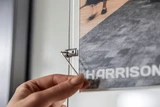
If a spec has landed on your desk that just says “hanging signage,” you already know the problem. A poster gripper, a cable kit and a clamp can all end up doing the same basic job (getting a sign up in the air), but they are built for different materials, different ceilings and different budgets. Mixing them up costs time on site and, occasionally, a sign that lands on someone’s head.
This guide breaks down the three main families of ceiling hanging components, how they differ, and how to match the right one to the job in front of you.
What Counts as Ceiling Hanging Signage?
Ceiling hanging signage covers any component designed to suspend a sign, poster or graphic from a ceiling, ceiling grid or overhead structure, rather than mounting it to a wall or standing it on the floor.
The appeal is simple. Overhead space above aisles, counters and entrances is usually free, visible from a distance, and untouched by footfall or trolleys. The trade-off is that overhead fixings need to be right first time. A wall-mounted sign that comes loose falls a few centimetres. A ceiling sign that comes loose falls on a customer.
This post covers the three component families you will meet most often when specifying hanging signage: poster grippers, cable-mounted kits and clamps, and the ceiling hooks and rings that connect them to the building itself.
Poster Grippers: How They Work
A poster gripper does exactly what the name suggests. It clamps along the top and bottom edge of a poster, banner or fabric graphic, holding the material taut and flat without piercing or gluing it. A loop or hanging point at the top lets you suspend the whole assembly from a hook, rail or ceiling fixing.
Harrison’s Skyliner range covers most of the variation you will need:
- Skyliner 24
A tight, snap-shut grip designed for thinner paper and card posters. The narrow jaw stops lightweight material from bending or tearing at the fixing point. - Skyliner 26
A side-hinged clamp built for fabric. The hinge makes it easier to load material without stretching it, and it holds fabric securely for the length of a campaign. - Skyliner 33
A heavier-duty gripper for thicker board, cut to order to match your sign width. - Skyliner 41
A round PVC tube with a V-slit, used to grip posters and banners for ceiling hanging. Hanging loops are sold separately, which gives you flexibility on how the finished sign attaches overhead.
Because grippers hold flexible material rather than a rigid panel, they suit posters and graphics that get swapped out often. A seasonal campaign, a new price promotion or a rebrand can go up and come down in minutes, with no re-drilling or re-fixing required.
Cable Kits and Clamps: How They Work
Cable-mounted kits solve a different problem: hanging a rigid sign, usually an acrylic panel, cleanly and under tension, so it holds its shape and position without a visible frame.
A typical cable-mounted kit uses a spring-loaded braided cable, fixed at the ceiling and, depending on the kit, also fixed to the floor or a wall. Screws, raw plugs and an Allen key are usually included for fitting. At the working end, a clamp grips the sign itself:
- Vertical Jaw Clamp
Grips the top of a vertical acrylic panel and is used with a length of cable rather than a fixed kit. - Single Panel Clamp
Grips the side edge of one panel. Works with the Floor to Ceiling and Wall Mounted Cable Kits. - Double Panel Clamp
Grips the side edges of two adjacent panels, useful when you are building a continuous run of signage rather than a single sign. - Free-Hanging Ceiling Cable with Clamp
A cable with a ceiling fixing at one end and a clamp at the other, built specifically to grip the top of a panel and let it hang freely with nothing anchoring the bottom.
Because the sign sits under tension between fixed points, cable-mounted signage tends to stay in place for longer than a poster display. It is the better fit for semi-permanent signage, wayfinding, and branded graphics that are not changed every few weeks.
Poster Grippers vs. Cable Kits and Clamps vs. Ceiling Hooks: A Side-by-Side Comparison
Choosing between these isn’t about which is “best.” It’s about matching the fixing to the sign you actually have.
| Component | Best For | Typical Material | Changeover Ease | Ceiling Type Needed | Typical Setting |
|---|---|---|---|---|---|
| Poster Grippers | Paper, card and fabric posters or banners | Plastic (PVC, ABS) or aluminium rail | Fast, tool-free swaps | Any, once a hanging point is fitted | Seasonal campaigns, promotions, retail windows |
| Cable Kits & Clamps | Rigid acrylic panels and semi-permanent signage | Aluminium cable with chrome or satin clamps | Slower, needs the cable tensioned and clamp repositioned | Solid ceiling for screw fixing | Wayfinding, branded displays, exhibitions |
| Ceiling Hooks & Rings | Connecting hardware for grippers, cables and lightweight signs | Plastic, zinc-plated steel, nickel | Depends on the hook type | Suspended grid or solid ceiling, hook-specific | Any application needing a fixing point overhead |
Choosing the Right Component for Your Application
Three questions usually settle it.
What is the sign made of?
Flexible paper, card or fabric calls for a gripper. A rigid acrylic panel calls for a cable and clamp system.
What ceiling are you fixing into?
A suspended grid ceiling suits push-fit or clip-on hooks, such as the Eagle Clip or T-Grip Ceiling Hook, that grip the grid bar directly without drilling. A solid ceiling gives you the option of a screw-fixed cable kit, which needs a firmer anchor point.
How often will the sign change?
Frequent changeovers favour grippers, since swapping a poster takes seconds. Longer-term signage favours cable and clamp systems, since the extra time spent tensioning the cable pays off in a sign that stays put.
These components are also often combined rather than used in isolation. A ceiling hook connects to a poster gripper’s hanging loop through an S-hook or split ring, and a cable kit’s floor fixing might be swapped for a wall fixing depending on the space. Metal display rings tend to be the quiet connector that ties a hook to a gripper or a sign to a chain, so check you have the right ring size alongside the main component.
What’s the Difference Between a Poster Gripper and a Cable Kit?
A poster gripper clamps the edges of a flexible poster, banner or fabric graphic and holds it flat, making it quick to change but better suited to lightweight material. A cable kit uses a tensioned cable and a separate clamp to suspend a rigid panel, such as acrylic, in a fixed position. In short, grippers are for material you plan to swap often, while cable kits are for signage you want to stay exactly where you put it.
- Poster grippers
Hold flexible material and change out fast. - Cable kits and clamps
Hold rigid panels under tension and stay in place for longer. - Ceiling hooks and rings
The connecting hardware that link either system to the ceiling itself.
Cost and Sourcing Considerations
Cost across this range depends less on the component family and more on three variables: material, length and kit complexity.
Plastic grippers and hooks generally cost less than aluminium or chrome-plated alternatives, though the aluminium and chrome options tend to hold their finish and shape better over repeated use. Grippers such as the Skyliner 24, 26 and 33 are cut to order, so the price reflects the length you need rather than a fixed unit cost. A standalone ceiling hook costs very little on its own, while a full floor-to-ceiling cable kit with fixings and a clamp represents a bigger single purchase, simply because it is doing more structural work.
As a trade supplier, Harrison Products works on a quote-based model for bespoke lengths and bulk orders, so the fastest way to get an accurate figure for your project is to get in touch with the team with your sign dimensions and ceiling type. Samples are available on request if you want to check a gripper’s grip strength or a cable’s finish before committing to a full order.
Getting It Right Overhead
The three families covered here solve different problems. Poster grippers suit flexible material that changes often. Cable kits and clamps suit rigid panels that need to stay exactly where you put them. Ceiling hooks and rings are the connecting hardware that makes either system work with your specific ceiling.
If you already know which family fits your project, browse the full Hanging Signage range to compare products directly.
For a wider look at how material choice affects signage performance indoors and outdoors, our Signage Materials 101 guide is a useful next read, and if you are planning signage around a seasonal push, our guide to seasonal in-store campaigns covers how to plan changeovers without disrupting the shop floor.
Got a ceiling type or a sign spec that doesn’t fit neatly into any of the above? Contact our team and we’ll help you find the right fixing.