
If you’ve spent any time browsing outdoor signage, you’ve likely seen “A-board” and “pavement sign” used to mean the same thing. They’re related, but they’re not quite synonyms. One describes a shape. The other describes a job. Getting the distinction right matters when you’re specifying signage for a client, because the wrong choice can mean a sign that blows over in a car park or one that’s too heavy to bring in every night.
Here’s how the two terms actually break down, and how to choose between them.
What is an A-Board?
An A-board is a hinged, double-sided sign that folds into the shape of the letter A. Two panels are joined at the top, so the sign stands freely on the ground and closes flat for storage or transport. That folding hinge is the defining feature. It’s what separates an A-board from other floor standing formats.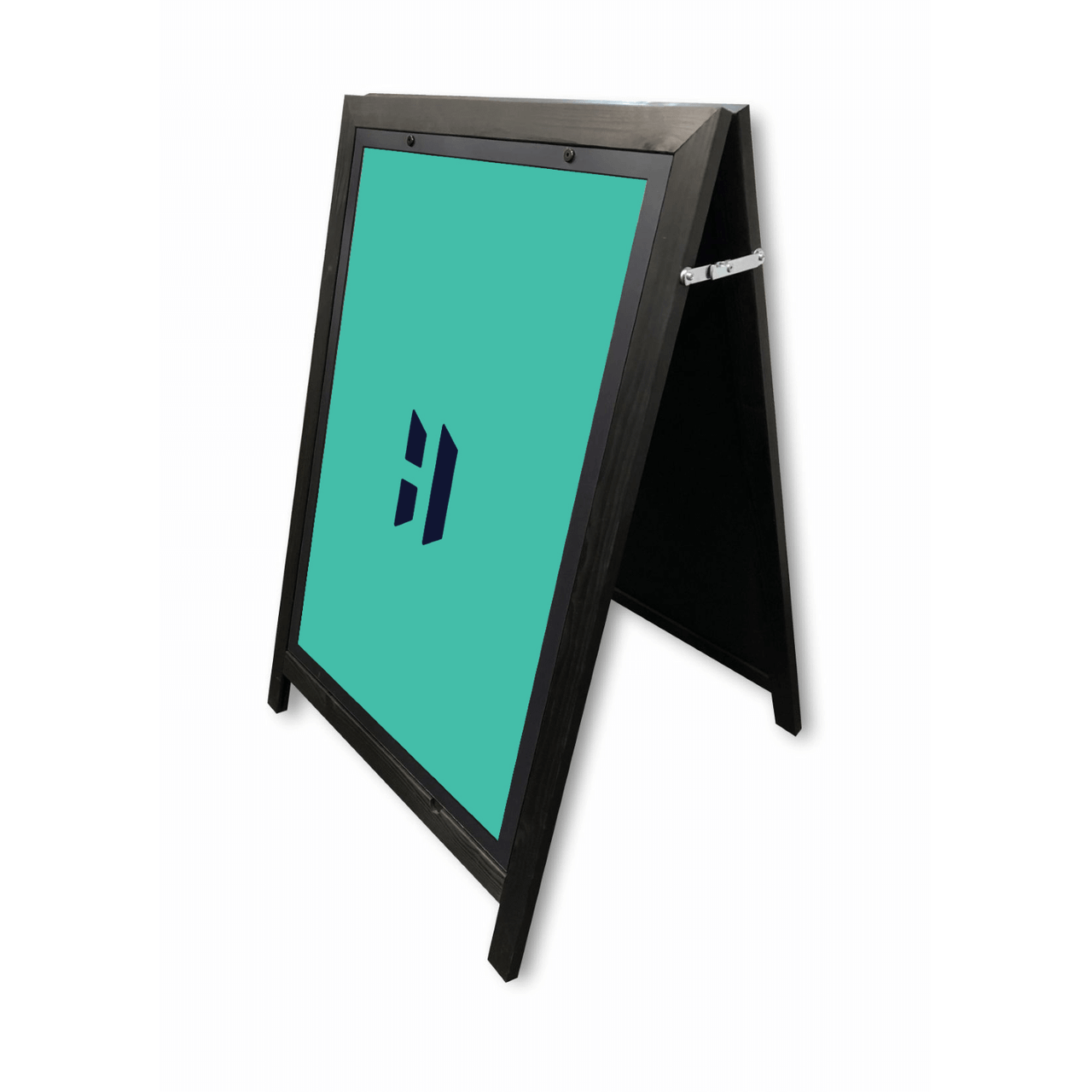
Harrison Products stocks A-boards in a few core materials, each suited to a different budget and use case:
- Wood
Traditional and often chosen for its café or high street look. The Wooden A-Board Pavement Sign takes an A1 poster, and the Wooden Chalk A-Board gives staff a reusable surface for daily specials. - Weatherproof frame designs
Options like the SignPro Lens and SignPro Deco use anti-glare covers and weather-resistant construction, built for boards that stay outside through UK weather rather than just a dry afternoon. - Metal snap frame
The Metal A-Board Pavement Sign uses a snap frame edge for quick poster changes, which suits businesses that update their message often.
A-boards turn up most in hospitality and independent retail: cafés, restaurants, salons, and shops that want something they can wheel in at closing time.
What is a Pavement Sign?
Pavement sign is the wider category. It covers any freestanding sign placed on a pavement or forecourt to catch passing footfall. An A-board is one type within that category, not the whole of it.
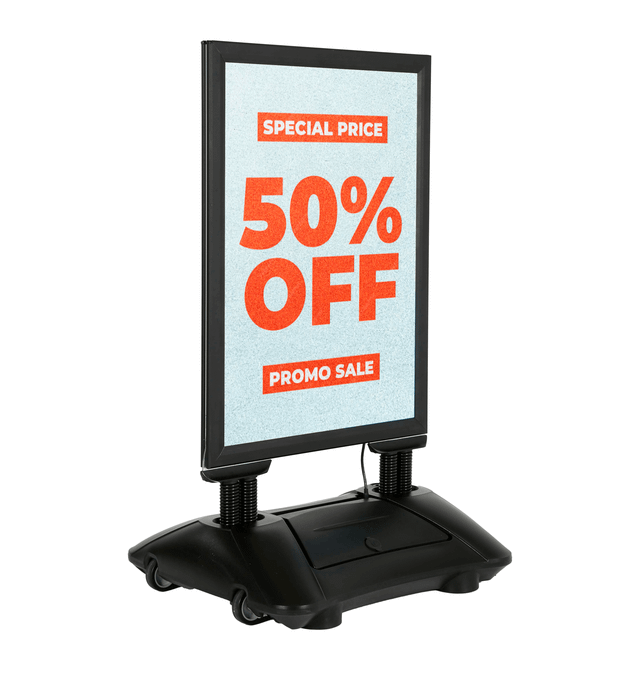
Other formats that fall under “pavement sign” but aren’t A-boards include:
- Water or sand filled swing frames
Heavier bases built for stability rather than portability, made to hold their ground in open, exposed spots. - Illuminated pavement signs
The WindPro Outdoor Illuminated LED Pavement Sign lights the message from within, useful where a shop needs to stay visible after dark. - Forecourt signs
Built on a concrete base or a water-filled base, designed for permanent or semi-permanent placement at a site entrance rather than daily setup and takedown.
Suppliers and search engines often blur the line between the two terms, which is exactly why the confusion exists in the first place.
A-Boards vs. Pavement Signs at a Glance
The short version: every A-board is a pavement sign, but not every pavement sign is an A-board.
An A-board is defined by its shape, a hinged A-frame that folds flat. Pavement sign is defined by its job, any freestanding outdoor sign placed to catch foot traffic. If you need something light enough to carry in overnight, choose an A-board. If you need something heavy enough to stay put in an exposed, windy spot, look at a wider pavement sign, such as a water-filled swing frame or forecourt unit.
Feature-by-Feature Comparison
| Feature | A-Board | Pavement / Forecourt Sign |
|---|---|---|
| Typical material | Wood, aluminium frame, metal snap frame | Steel, brushed aluminium, weighted plastic |
| Base type | Two hinged panels, no separate base | Water-filled, concrete, or fixed base |
| Wind stability | Moderate, needs care in open areas | High, built for exposed sites |
| Portability | High, folds flat, easy to store indoors | Low to moderate, heavier bases |
| Print capacity | A1, A2, custom panel or chalk surface | A0, A1, some illuminated formats |
| Typical price (excl. VAT) | £45.82 to £188.65 | £141.41 to £733.04, or quote based |
The pattern holds across the range. A-boards give up some wind resistance in exchange for being light enough to move. Forecourt and illuminated signs give up that portability for a base that won’t shift in bad weather.
Pricing Analysis
Budget for this category splits roughly into three tiers.
At the entry level, metal snap-frame A-boards start from £45.82, a sensible option where the sign will be updated often and doesn’t need heavy-duty weatherproofing.
The mid-range covers most wooden A-boards and standard poster pavement signs, spanning roughly £92 to £190. This is where most café and retail A-board orders land, including the Wooden A-Board and Master Flex A1 Poster Pavement Sign.
At the top end, illuminated and heavy-base forecourt signs run £700 and up, or are quoted individually where a bespoke base or fixing is involved. That cost buys stability and visibility that a folding A-board simply can’t match in an exposed forecourt location.
The right budget depends less on the headline price and more on three questions: how much footfall the sign needs to catch, how exposed the site is to wind, and whether someone will actually bring it indoors each night.
Pros, Cons and Use Cases by Buyer Type
A-boards
Light, foldable, and inexpensive to replace if damaged. Poster or chalk panels are quick to update, which suits businesses that change their message daily. The trade-off is stability. In an exposed spot, a lightweight A-board can shift or blow over, and someone needs to remember to bring it in overnight.
For shopfitters and print management companies working with hospitality clients such as cafés, restaurants, and independent retailers, A-boards are usually the right specification. They’re affordable at volume and easy for site staff to manage without training.
Pavement and forecourt signs
Built for sites where the sign stays out for longer periods, or where wind exposure rules out anything lightweight. Illuminated options extend visibility into the evening. The trade-off is weight and cost. A water-filled or concrete-based unit isn’t something one person moves alone, and the price reflects that.
For POS manufacturers and print management companies specifying for retail chain rollouts or forecourt locations, this is the category to reach for when the brief calls for durability over daily portability, particularly at petrol forecourts, retail parks, and larger footprint stores.
Conclusion and Recommendation
A-board describes a shape: two hinged panels that fold flat. Pavement sign describes a job: any freestanding sign built to catch foot traffic outdoors. Every A-board qualifies as a pavement sign, but plenty of pavement signs (water-filled swing frames, illuminated units, forecourt bases) are built differently and solve a different problem.
When you’re specifying for a client, the decision usually comes down to three things: expected footfall, wind exposure at the site, and whether the sign needs to come indoors every night. Light footfall and sheltered doorways point toward an A-board. Open forecourts and long-term placement point toward a heavier pavement sign.
Browse the full A-Board Signs range or the Pavement & Forecourt Signs range to compare options by material and size. For bulk orders or multi-site rollouts, get in touch with the Harrison Products trade team for a tailored quote.
Related reading: Signage Materials 101 and Why Wall-Mounted Signage Matters.